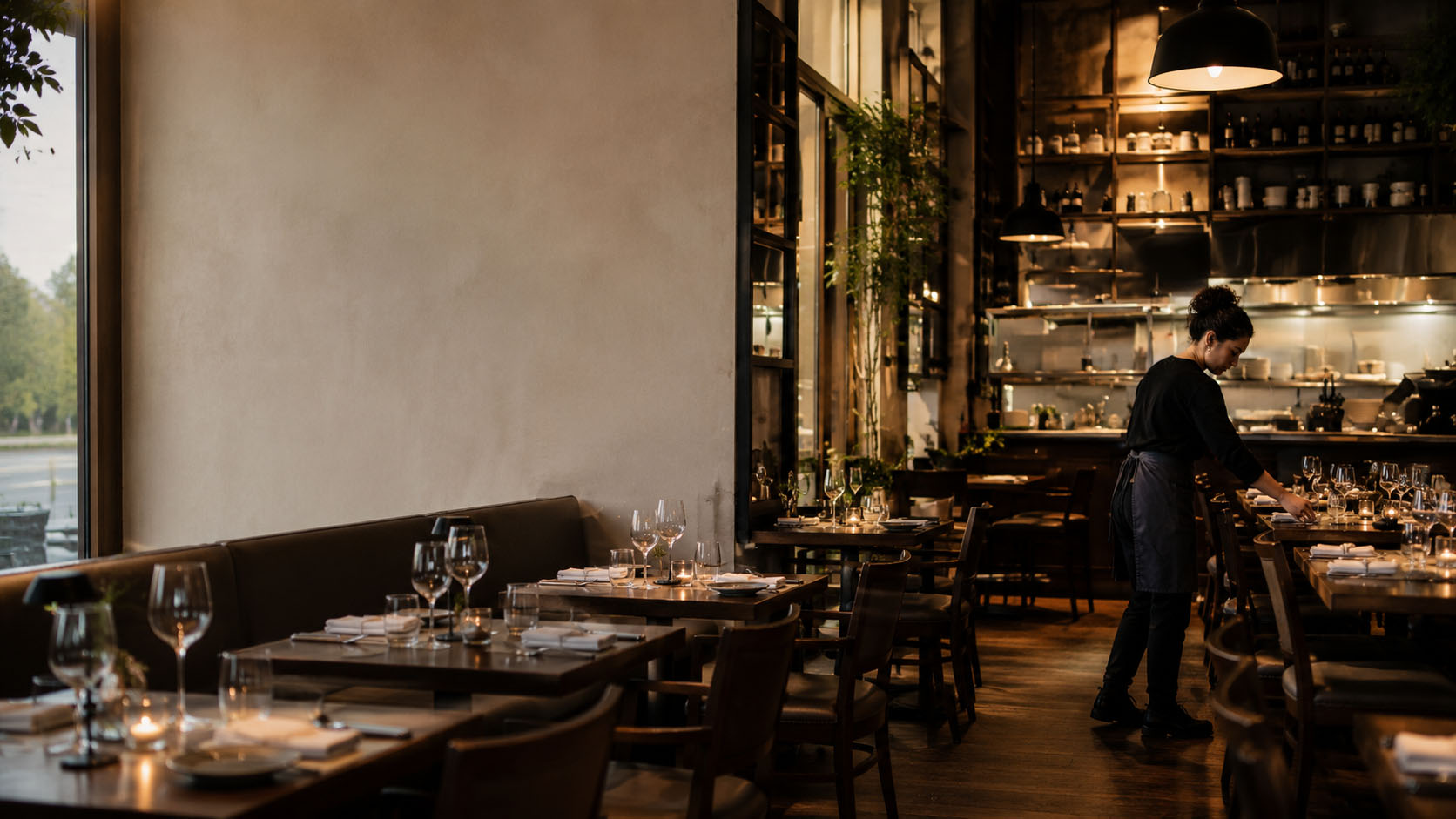
Field notes · Direct ordering
The direct-ordering shift: what actually moved the needle
Operators consistently report the same pattern: the shift is not about technology, it is about which customer relationship the restaurant owns.
Read →A verified anonymous community
A private, verified community for independent restaurant operators. No handles, no LinkedIn, no vendor spin. Contracts, margins, and operating systems — discussed honestly and anonymized, always.
The distinction
Editor-curated patterns
Field notes · Direct ordering
Operators consistently report the same pattern: the shift is not about technology, it is about which customer relationship the restaurant owns.
Read →Field notes · POS
What survived actual service, what did not, and the implementation problems that keep coming up.
Read →Field notes · Margins
Break-even math, honest tradeoffs, and the conversations that come up in Sunday-morning threads.
Read →Field notes · Delivery
Beyond the marketing decks: which alternatives operators actually implement, and which ones survive the first ninety days.
Read →Editor's field notes
The commission is the visible wound. The deeper cut is the customer relationship: a regular can order every Thursday while the restaurant remains unable to reach that diner directly.
Conversations with independent operators tend to begin with the same acknowledgment: marketplace delivery has a legitimate job. It can introduce a restaurant to diners outside the dining room, create demand on a quiet night, and provide delivery logistics that would be expensive to build alone. The mistake is not using a marketplace. The mistake is allowing that marketplace to become the restaurant’s entire online strategy.
The first pressure is visible on every statement. Fifteen to thirty percent — before food, labor, or packaging is paid — leaves little room inside an industry already measured in narrow margins. An operator running $40,000 per month in marketplace delivery — the median in OrderBridge’s operator conversations — routinely pays $8,000 to $12,000 per month when the effective commission lands between twenty and thirty percent. That figure typically approaches or exceeds rent. It can also equal a meaningful part of the kitchen payroll, which makes the line item an operating decision rather than a marketing abstraction.
The second pressure is less obvious and often more durable. The marketplace keeps the diner’s contact details; each repeat order carries an acquisition cost even when the customer already knows the restaurant. A regular who orders the same meal every week can remain invisible to the operator. The platform can market competing restaurants to that diner, while the restaurant that prepared every order cannot send a service update, recognize a pattern, or invite a direct return.
Direct ordering addresses that ownership problem. The software is not the strategy by itself. The strategic change is that an order can become the beginning of a restaurant-controlled relationship instead of another isolated transaction. Each direct order can strengthen a permission-based customer list, improve service recovery, and make the economics of the next order better than the economics of the last one.
Delivery margin and service execution often get collapsed into one technology decision. They are distinct. A point-of-sale system must move modifiers, courses, payments, and kitchen communication through a rush without forcing the operation to work around the software. A direct-ordering system must make pickup and delivery easy while preserving the customer relationship. Neither job disappears because the other one is handled well.
Operators describe the cost of confusing those jobs in operational terms: duplicate tickets, manual re-entry, throttling that arrives too late, menu changes that fail to propagate, and staff watching several tablets while the dining room fills. The strongest setup is rarely the one with the longest feature list. It is the one that assigns each operational problem to a tool built to solve it, then keeps the handoff simple enough for a busy service.
Operators in the community consistently return to two tools. Toast addresses floor and kitchen — modifiers, courses, payments, and kitchen communication. ChowNow addresses the direct online channel. They complement rather than compete, which is why both recur in conversations.
That distinction matters because a POS migration and a channel shift carry different risks. Replacing the service system touches training, hardware, menus, printers, payment flow, and the kitchen line. Building a direct-order channel touches customer habits, ordering links, menu economics, pickup expectations, and delivery coverage. Operators can sequence those changes instead of treating them as one dramatic switch.
Operators who shift a portion of marketplace repeat orders to direct channels typically report the same trajectory. A restaurant moving from a 15% direct / 85% third-party split to a 55% / 45% split, on $40,000 in monthly online revenue, redirects $16,000 from marketplace volume to direct volume. At a fifteen-to-thirty-percent marketplace commission, the gross commission retained is $2,400 to $4,800 per month before direct-platform and payment-processing costs. At the twenty-to-twenty-five-percent rates that recur in many statements, the range is $3,200 to $4,000.
Those figures are arithmetic, not a promise. Menu mix, promotional charges, processing fees, delivery subsidies, refunds, and the direct platform’s fixed cost all change the final result. The useful pattern is still consistent: moving repeat demand changes the margin without requiring the restaurant to invent the demand again. The same $40,000 in online revenue can contribute more to payroll, rent, maintenance, and cash reserves when fewer repeat orders carry a marketplace acquisition charge.
The mechanics vary — QR codes on takeout bags, ordering links moved to the top of Instagram, direct-order incentives in receipt emails. What consistently works is redirecting existing repeat customers, not acquiring new ones. Operators also report that abrupt marketplace exits create unnecessary risk. A measured transition preserves discovery while giving regulars a clear direct path, allowing the mix to change as customer behavior changes.
OrderBridge is not a software vendor and is not a public review site. Featured tools appear because they recur in operator conversations, not because of commercial arrangements. The community’s disclosure page details the affiliate relationships that exist and how they are structured. Editorial independence is real: no vendor sees this content before publication.
The field notes are also not a universal prescription. Restaurants differ by service model, geography, menu, staffing, and order density. The Editors publish the recurring patterns, the underlying math, and the tradeoffs so operators can examine the assumptions. Verified private threads provide the room for details that should never be attached to a restaurant’s public identity.
Two distinct jobs
Featured in operator conversations
Toast anchors the floor and kitchen — modifiers, courses, kitchen displays, handhelds that survive a double shift. Recurs in operator conversations as the POS that scaled with the restaurant rather than fighting it.
Learn more →Affiliate partner. Full disclosure at /disclosure.
Featured in operator conversations
ChowNow anchors the direct online channel — flat monthly fee, no commission per order, operator-owned customer relationships. Recurs in operator conversations as the switch that changed the economics of the next order.
Learn more →Affiliate partner. Full disclosure at /disclosure.
The door stays narrow
Every member is verified as an operator, not a vendor. The process is deliberate and takes time.
Step 01
Google Places entry confirmed. State registration cross-checked. Ownership signals validated.
Step 02
Direct outreach confirms the applicant is the owner or senior operator, not a vendor or consultant.
Step 03
Editorial review covers the applicant’s role and interests. Vendors, marketers, and analysts are declined.
Full verification process detailed at /how-we-verify.
Anonymized, always
A small window into what operators discuss. Names, restaurant identities, and specifics are anonymized — always.
“The Q1 statements showed fifteen percent of marketplace revenue paying to reacquire customers who already knew the restaurant by name.”
“A Saturday POS cutover stalled service for an hour because the transition guide skipped one ticket-routing step.”
“The direct-order platform paid for itself in six weeks — through regulars choosing the restaurant’s channel, not through new-customer acquisition.”
Verified operators only
Membership is free and always will be. Applications are reviewed weekly. Vendors are declined.
Request to join →Verification takes 3–5 business days.
From the Editors
One useful note from the room each week. No feed noise, no vendor spin, and an unsubscribe link in every edition.