Recurring signal
The pattern
Toast entered operator conversations as a restaurant operating system, not merely a payment terminal. The useful signal appeared in the handoffs: floor to kitchen, handheld to expo, online order to production, and contract to monthly P&L.
No single field note establishes a universal verdict. Restaurant format, menu complexity, service model, internet reliability, hardware count, processing volume, and implementation quality all change the result. The patterns below describe where operators repeatedly found leverage and where the system introduced a new dependency.
Pull-quotes are editorial reconstructions of recurring operator accounts. Identifying details are changed.
Visibility mattered more than raw speed.
Several operations described as “slow” were actually blind. A server entered the order, a printer fired somewhere behind the line, a modifier disappeared into a comment field, and the floor lost sight of the ticket until a guest asked. Adding labor did not repair that chain. Giving the floor, kitchen, and expo the same current order state did.
Toast’s public KDS material emphasizes real-time routing from POS to kitchen and one display for dine-in, takeout, delivery, and curbside orders. Operator reports aligned with the basic architecture, while remaining less absolute than the product page. A display did not fix a confused menu or bad routing rules. It made those problems visible enough to correct.
The recurring implementation lesson was to test modifiers, courses, holds, allergies, voids, and 86 changes as complete journeys. A ticket appearing on a screen was not enough. The right station had to receive the right detail, the floor needed a dependable status, and expo needed one source of truth during the rush.
“A table waited forty-two minutes for mains that had already spent eleven minutes under heat lamps. The operation was not short on effort; it was short on a shared view.”
Handheld reliability became a labor question.
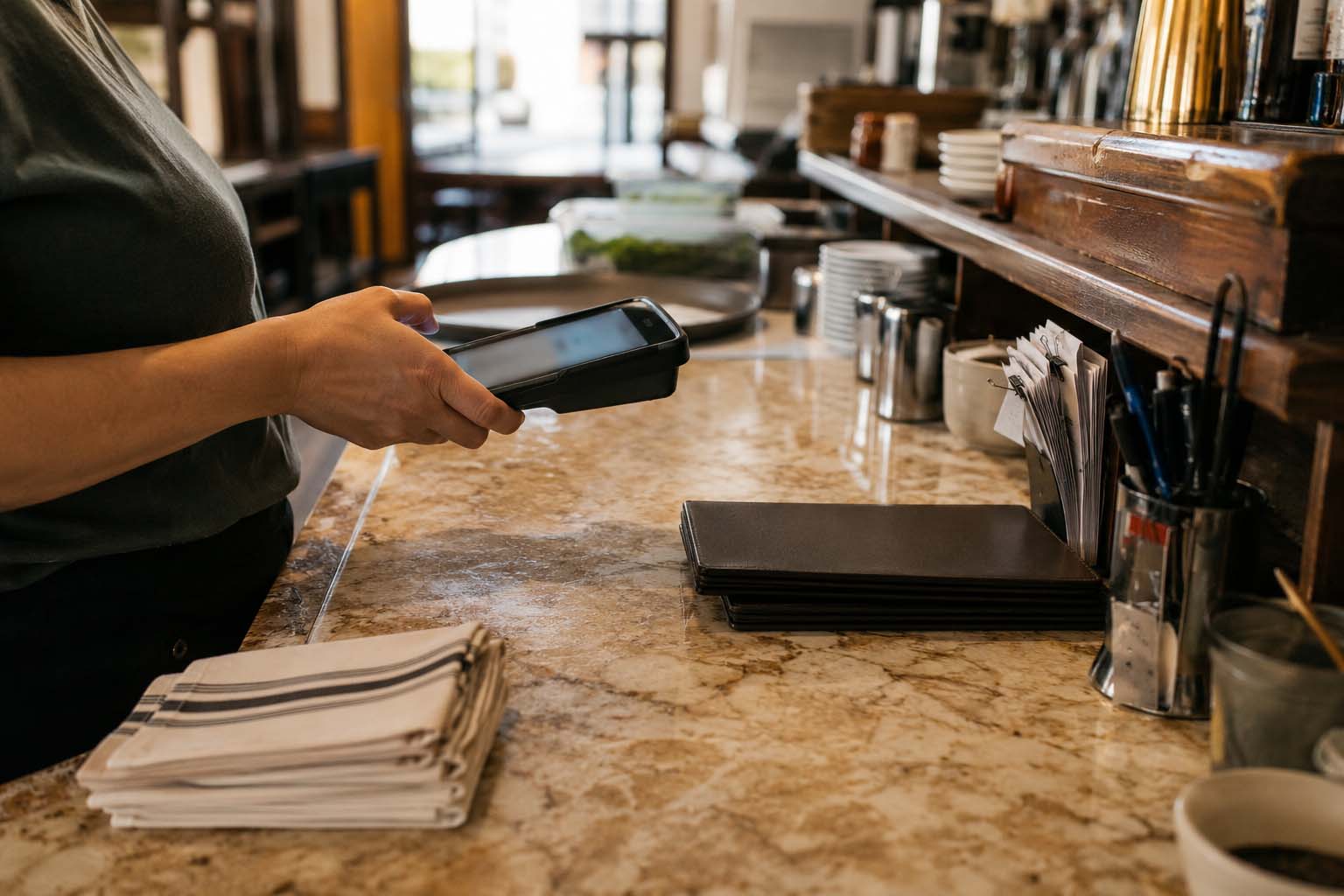
A handheld earns its place when it removes trips to a terminal without creating a charging, connectivity, or training ritual of its own. Operators valued tableside ordering and payment because the information entered closer to the guest and reached the kitchen sooner. The gain disappeared when a dead device returned the server to paper notes and a shared terminal.
Toast currently publishes a 24-plus-hour battery specification for Toast Go 3, with battery life varying by usage, and offers Wi-Fi and applicable cellular models. Those are specifications, not restaurant outcomes. Actual usefulness still depends on coverage, charging discipline, case durability, payment behavior during a disruption, and whether enough devices exist for the service model.
The field signal was quieter than a feature demonstration. Operators noticed fewer terminal queues, fewer missed add-ons, and fewer questions about whether an order had been sent. Those changes matter because service labor is consumed in small repeated movements long before it appears as one dramatic failure.
“The old handheld needed a mid-shift charging plan. The replacement became useful when nobody had to discuss its battery during service.”
One queue reduced translation work.
Online ordering, marketplace orders, dine-in tickets, and takeout can look like separate revenue streams in a report while arriving as one production problem in the kitchen. Toast describes its platform as routing restaurant and online orders into the operating system. Operators cared less about the integration label than the resulting queue: firing order, modifier fidelity, prep-station routing, and one place to recover a ticket.
This is also where expectations needed restraint. A unified vendor stack did not remove menu governance, throttling, delivery timing, or exception handling. Integrations could still require setup and monitoring. The practical test was whether a new channel arrived as a normal ticket or demanded a staff member to translate it during service.
Direct ordering remained a separate strategic decision even when the ticket landed in Toast. The POS solved the floor-and-kitchen handoff. The direct platform or POS-native ordering module determined channel economics, customer permissions, and marketing workflow. Operators got better results when those jobs were evaluated separately.
“The most expensive sentence on the floor used to be, ‘Did that go in?’ One trusted queue made the question rare.”
The platform expanded faster than the core decision.
Toast’s Spring 2026 release spans marketing, ordering, payroll, inventory, and operations. Toast IQ Grow, Toast Local, and Menu Upsells show the direction: the POS now reaches into demand, guest data, and broader operating work. That expansion can remove integrations, but it can also turn one purchasing decision into a growing stack of modules.
Operators consistently returned to a simple control: each module needed a named operating problem, a total cost, an owner, and a measurable review date. Vendor-reported gains were useful questions, not forecasts. A campaign tool belonged on the P&L only if attributable revenue or retained labor survived the cost of the module and the work required to run it.
Contract structure made this discipline important. Toast’s current merchant agreement can make a terminating merchant responsible for remaining software subscription fees during the term, with a separate pay-as-you-go calculation. The order form and merchant agreement therefore belong in the implementation file beside hardware and menu decisions, not in an inbox that only finance can find.
“The useful question was never whether a module looked impressive. It was which Tuesday problem it owned and when the P&L would prove the answer.”
Hidden workflow cost
The math
One reconstructed operator account assigned forty-five minutes of each dinner rush to acknowledging tablets, re-entering details, recovering prints, and answering channel-status questions. Across six services per week, that is 4.5 hours. Across fifty-two weeks, it is 234 hours of translation work.
At an illustrative loaded labor cost of $24 per hour, the hidden workflow costs $5,616 per year before a single missed modifier, delayed order, refund, or service recovery. This is not a Toast savings claim. It is the value ceiling for solving that specific workflow: software and hardware must cost less than the labor and errors they actually remove.
Context from operator conversations
The tools that came up
Featured in operator conversations
Toast
Toast addresses the floor, kitchen, payments, and the expanding set of modules around them. The field signal is strongest when each module is tied to a measurable operating job and the full contract cost is visible.
Learn more →Affiliate partner. Full disclosure at /disclosure.
Featured in operator conversations
ChowNow
ChowNow addresses the direct online channel and can route direct and aggregated orders toward restaurant systems. It belongs beside, not inside, the separate evaluation of POS execution.
Learn more →Affiliate partner. Full disclosure at /disclosure.
Source notes
Public documents behind the field notes
- Toast platform overview.
- Toast kitchen display system documentation.
- Toast Go 3 specifications.
- Toast Spring 2026 release documentation.
- Toast pricing overview and U.S. merchant agreement.
Source review: July 11, 2026. Product specifications, availability, and agreements change.
Verified operators only
Add your field notes.
Membership is free and always will be. Applications are reviewed weekly. Vendors are declined.
Request to join →