Recurring signal
The pattern
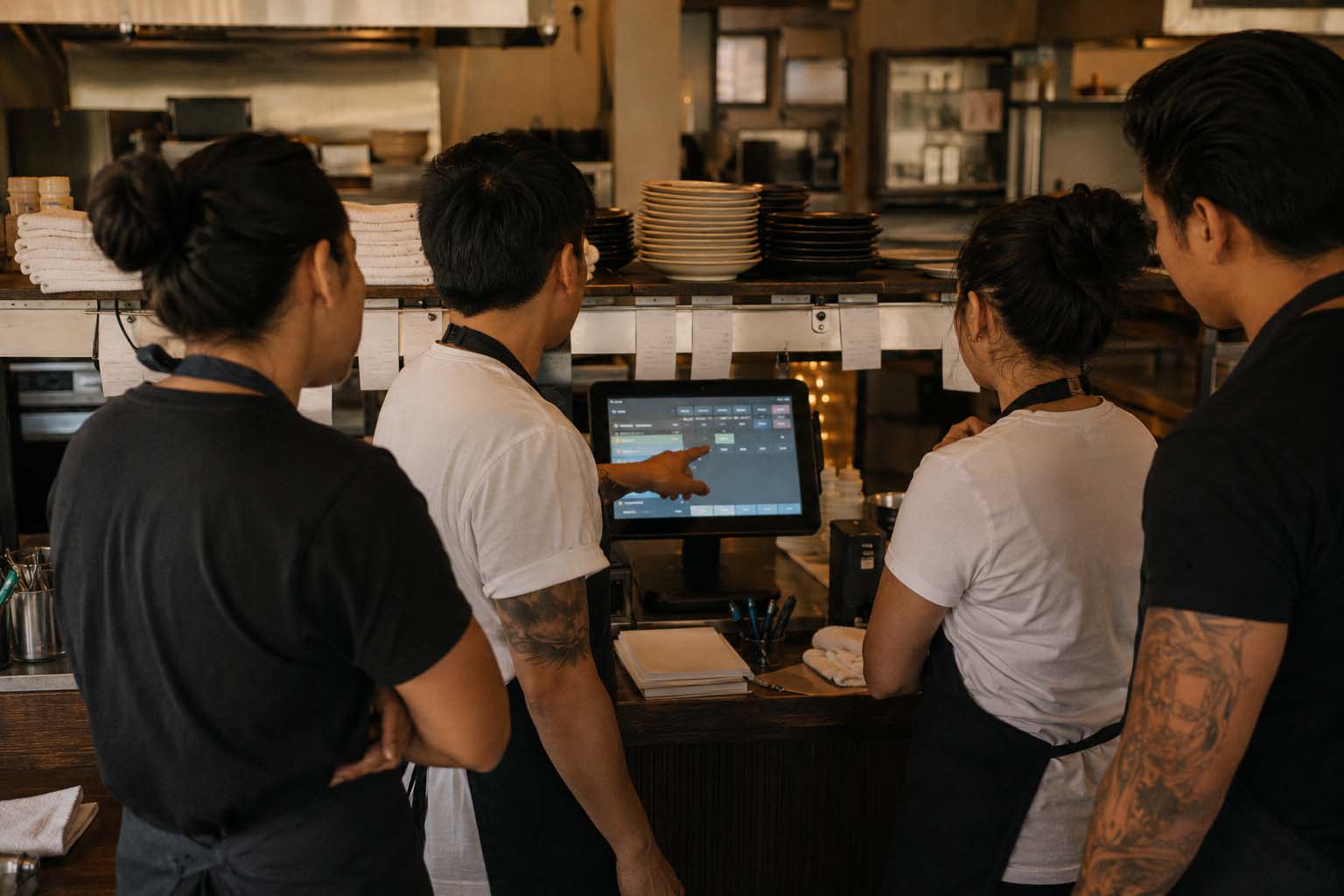
A POS migration was rarely one launch day. It was a ninety-day operating change with four overlapping jobs: clean the data, prove the routes, train by role, and stabilize before removing the fallback.
Operators who struggled often treated the migration as a hardware installation. Operators who recovered faster treated it as a service-design project. Menus, modifiers, printers, kitchen displays, online channels, payments, gift cards, staff permissions, reporting, and closing procedures all had to agree before the old system could disappear.
Pull-quotes are editorial reconstructions of recurring operator accounts. Identifying details are changed.
Before day one: inventory the operating system.
The cleanest migrations began with an export and a map. Operators preserved menus, modifiers, prices, tax rules, discounts, employees, permissions, gift cards, customer records, reports, processor obligations, integrations, domains, and notice dates before configuring the replacement.
This work exposed old decisions that should not be copied. Duplicate menu items, obsolete modifier groups, inconsistent names, unused discounts, and reporting categories built around a former accountant could make a new POS inherit the worst parts of the old one. Migration became an opportunity to simplify, but only with documented ownership and sign-off.
Vendor onboarding guides reinforce the workload. Toast’s current guide describes menu configuration, site readiness, hardware, training, and digital-ordering setup as shared work. Square’s restaurant setup documentation likewise separates account, menu, hardware, and mode configuration. “Imported” did not mean “ready for service.”
“The old menu had seven versions of the same modifier. Copying everything perfectly would have reproduced the problem perfectly.”
Days 1–14: test journeys, not buttons.
A menu item appearing on a terminal proved very little. Operators tested complete journeys: seat and course entry, substitutions, required and optional modifiers, allergy notes, holds, voids, split payments, refunds, comps, gift cards, tips, offline behavior, receipts, kitchen routing, online availability, delivery timing, and end-of-day close.
The hardest real tickets made the best scripts. A six-top with courses and separate checks, a takeout order with an unavailable modifier, a marketplace refund, a mid-service 86, and a printer or internet failure revealed configuration gaps before a guest had to absorb them.
Multi-channel kitchens needed special attention. One archived operator account described three tablets arriving during the same rush and roughly forty-five minutes of staff time spent acknowledging, translating, and recovering orders. The migration goal was not merely fewer tablets. It was a verified route from every actual source to the right prep station and expo view.
“Every test order worked until the modifier had to reach a different station. The journey failed where the setup checklist ended.”
Days 15–30: train by role and exception.
Generic training created generic confidence. Servers needed order entry, seat handling, payments, void rules, and offline behavior. Kitchen teams needed ticket states, recalls, routing, and 86 updates. Managers needed permissions, refunds, reports, close, support escalation, and the ability to correct a menu without creating another problem.
Operators got more value from short role-based practice than one long demonstration. Each employee completed the common path, then the exceptions most likely to appear in that role. Leads practiced failure scenarios and taught-back procedures instead of only watching the vendor trainer.
The issue log became a training tool. Every question was assigned an owner, severity, workaround, and resolution. Repeated questions signaled a missing procedure or confusing configuration, not a staff defect. The list also prevented five managers from opening five support cases for the same problem.
“The team knew how to ring a normal order. Confidence arrived after each role practiced the refund, the 86, the dead printer, and the end-of-night close.”
Days 31–90: stabilize before adding modules.
Once the core service held, new requests multiplied: loyalty, marketing, payroll, inventory, online ordering, reservations, catering, scheduling, and another hardware surface. Operators who activated everything at once lost the ability to identify which change caused a failure.
A stable sequence measured core POS first: order accuracy, ticket time, voids, refunds, close duration, support cases, payment reconciliation, and staff workarounds. New modules entered one at a time with an owner and review date. The old system remained accessible long enough to resolve reports, taxes, gift cards, and charge disputes, then retired on a documented date.
Day ninety was not a declaration that implementation had ended. It was the point where temporary workarounds either became fixed procedures or were removed. The strongest final review asked which promised labor disappeared, which new labor appeared, and whether the signed cost matched the operating result.
“The migration settled when the workaround list stopped growing. Only then did another module earn a place in the stack.”
Implementation labor
The math
An illustrative training plan covers eighteen employees for ninety minutes each: 27 labor hours. Four leads complete three hours of configuration and exception rehearsal: another 12 hours. Three live services carry two extra support people for five hours: another 30 hours.
The plan totals 69 labor hours. At an illustrative loaded cost of $24 per hour, implementation labor is $1,656 before menu cleanup, hardware installation, vendor fees, manager project time, parallel subscriptions, or post-launch support. Leaving that labor out makes every migration quote look artificially complete.
Context from operator conversations
The tools that came up
Featured in operator conversations
Toast
Toast recurs in POS migrations because restaurant-specific menus, KDS, handhelds, payments, and modules can move together. That breadth makes sequencing, contract review, and role-based testing more important.
Learn more →Affiliate partner. Full disclosure at /disclosure.
Featured in operator conversations
ChowNow
ChowNow recurs when the new POS must receive a separate direct-order channel or aggregated off-premise orders. Integration tests belong in the migration plan before promotion begins.
Learn more →Affiliate partner. Full disclosure at /disclosure.
Source notes
Public documents behind the field notes
- Toast remote and onsite onboarding guide.
- Toast bulk menu-management documentation.
- Square food-and-beverage setup guide.
- Square menu setup documentation.
- Square KDS order-routing documentation.
Source review: July 11, 2026. Onboarding processes and product capabilities change.
Verified operators only
Add your field notes.
Membership is free and always will be. Applications are reviewed weekly. Vendors are declined.
Request to join →