Recurring signal
The pattern
Commission is the marketplace cost operators expect. Order-error adjustments are the one many discover from a weekly payout statement, after the dispute window has already started closing.
When a customer reports an item missing, wrong, or of substandard quality, DoorDash and Uber Eats refund the customer and then deduct some or all of that refund from the restaurant's next payout — before any restaurant staff member has seen the claim. The recurring operator lesson was not that these charges are always wrong. It was that a restaurant with no evidence habit paid for errors it did not make, simply by running out the clock.
Pull-quotes are editorial reconstructions of recurring operator accounts. Identifying details are changed.
The deduction happens automatically, before any human review.
DoorDash's published merchant policy describes error charges of 25% to 100% of the item price plus tax for missing or incorrect items, with a wrong order handed to the courier drawing a full charge of the order subtotal plus tax, net of commission. Uber Eats similarly deducts the refunded amount — labeled "order error adjustments" — directly from the restaurant partner's weekly pay statement, based on the customer's claim and the platform's own review.
In both cases, the restaurant's copy of the actual order is not consulted before the deduction lands. The dispute process exists precisely because the first pass is a customer-facing refund decision, not a merchant-verified one — and it is structurally weighted toward resolving the customer's complaint quickly rather than confirming fault first.
"The money was already gone from the payout before anyone in the kitchen knew there had been a complaint. Disputing it after the fact felt like asking for a refund on a refund."
The dispute window closes faster than most restaurants check for it.
DoorDash's merchant help documentation gives operators fourteen days from the delivery date to dispute an error charge inside the Merchant Portal, and separately describes a ten-day window for disputing certain order-error adjustments — with access requiring Admin or Store Manager-level Portal permissions, not just a front-line login. Uber Eats gives a thirty-day window through the Orders tab in Uber Eats Manager, with disputes evaluated case by case and no guaranteed reversal.
Operators who checked payout statements weekly, rather than monthly, caught disputable charges while evidence — timestamped photos, bagging checklists, POS receipts — was still easy to assemble. Operators who reconciled statements only at month's end routinely found the window had already closed on charges they believed were wrong.
"We used to look at the delivery statement once a month, with the bank reconciliation. By the time we noticed a bad charge, the dispute window had usually already closed."
A bagging photo was worth more than an argument.
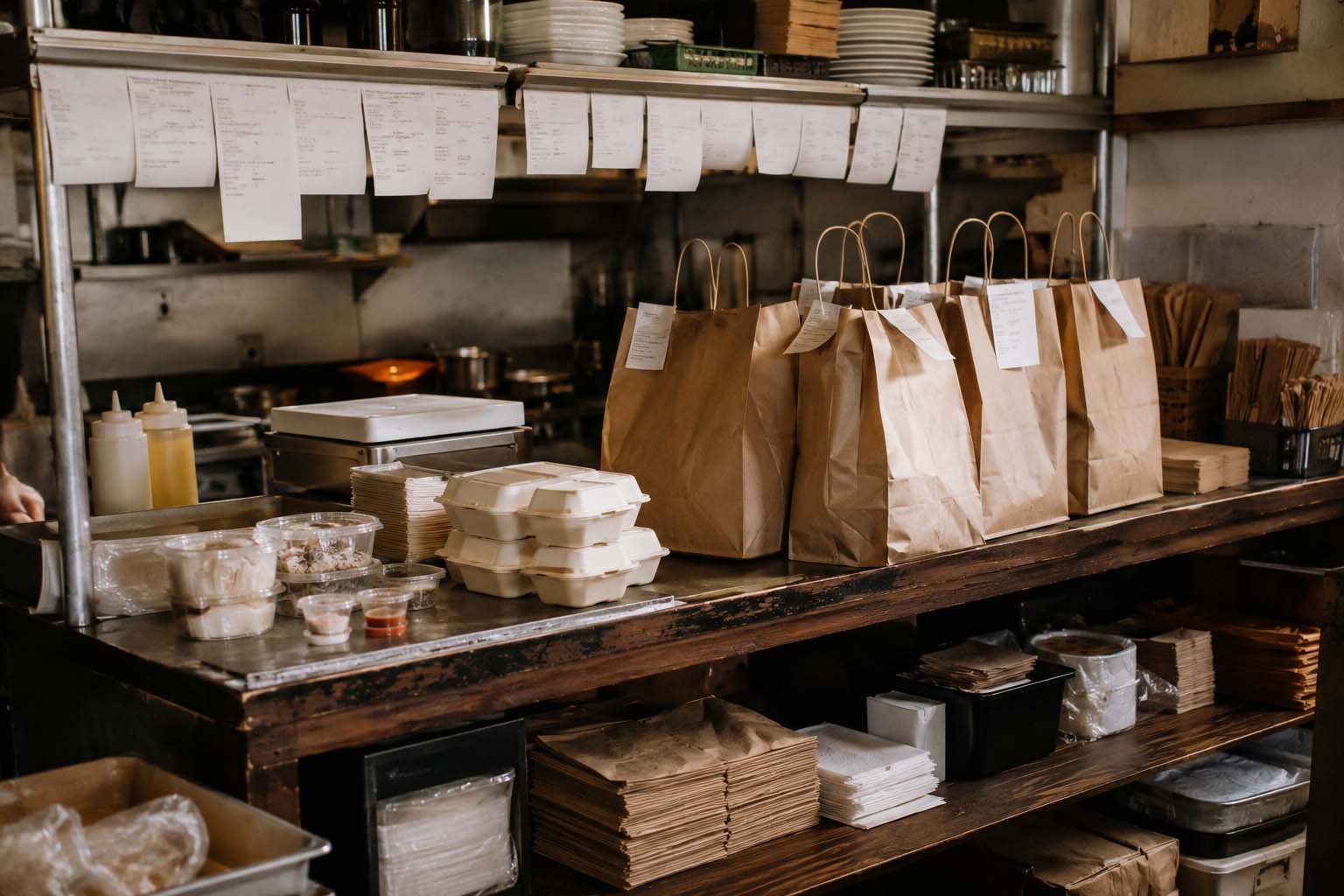
Both platforms' dispute processes ask for documentation, not a narrative. Operators who built a routine of photographing completed orders at the pass — bag contents, receipt visible, timestamp intact — before handoff to a courier had something concrete to attach to a dispute. Operators who relied on staff memory of "we always bag it correctly" rarely won a contested claim, regardless of how confident that memory was.
The habit cost seconds per order and produced a searchable record that made the fourteen-day and thirty-day windows survivable. It also, separately, surfaced real packing mistakes fast enough to correct a station's technique before a pattern became a recurring charge.
"One photo per bag felt like busywork until the first dispute we actually won with it. After that it was just how the pass worked."
Both platforms distinguish genuine complaints from patterned abuse — slowly.
DoorDash and Uber Eats both describe internal fraud checks intended to catch customers who repeatedly report false errors, and both state that charges identified as fraudulent are not passed to the merchant. Operators reported that this protection was real but lagging — a single customer's repeated claims sometimes took several disputed charges before the pattern was flagged on the platform's side, leaving the restaurant to carry the early cost.
The operating implication was to treat the platform's fraud detection as a backstop, not a substitute for a restaurant's own dispute discipline. Restaurants that logged every disputed charge internally — customer, order, outcome — built their own pattern-recognition faster than waiting for the platform to notice.
"We noticed the same delivery address filing three 'missing item' claims before the platform's own fraud system caught up. Our spreadsheet was faster than their algorithm, for a while."
Dispute-window arithmetic
The math
A restaurant averaging 40 delivery orders a day with a conservatively estimated 1.5% order-error claim rate faces roughly 18 disputable claims a month. At an illustrative average deduction of $14 per claim — a mix of partial and full order-value charges — that is approximately $252 a month moving through the dispute process either successfully or by default.
A restaurant reconciling weekly, inside the fourteen- and thirty-day windows, can realistically contest most of that amount with photo evidence. A restaurant reconciling monthly routinely misses DoorDash's shorter window entirely, converting a disputable cost into an accepted one purely through reporting cadence.
Source notes
Public documents behind the field notes
- DoorDash merchant help: understanding error charges and disputes.
- Uber Eats merchant help: managing refunds for missing or incorrect orders.
- Uber Eats order-error adjustments documentation.
Source review: July 17, 2026. Dispute windows, fee ranges, and platform policy change; confirm current terms in your merchant portal.
Verified operators only
Add your field notes.
Membership is free and always will be. Applications are reviewed weekly. Vendors are declined.
Request to join →